quick summary
- Discover the signs that indicate your startup has outgrown shared coworking and could benefit from a private office.
- Understand the difference between the apparent cost and the real cost of a private office versus multiple coworking spaces.
- Learn why contractual flexibility can be as important as physical space for a growing business.
- Learn what services are typically included in a private serviced office and how they can reduce the operational burden on the team.
- Understand how to plan a transition to a private office without disrupting daily work or impacting productivity.
The moment to leave the shared coworking It doesn't happen when your startup reaches a magic number of employees. It happens when the space starts creating more friction than support.
If your team can no longer sit together, if important calls are made in hallways, if internal meetings depend on finding a free room, or if you waste time every week organizing where to work, it's probably time to consider a private office.
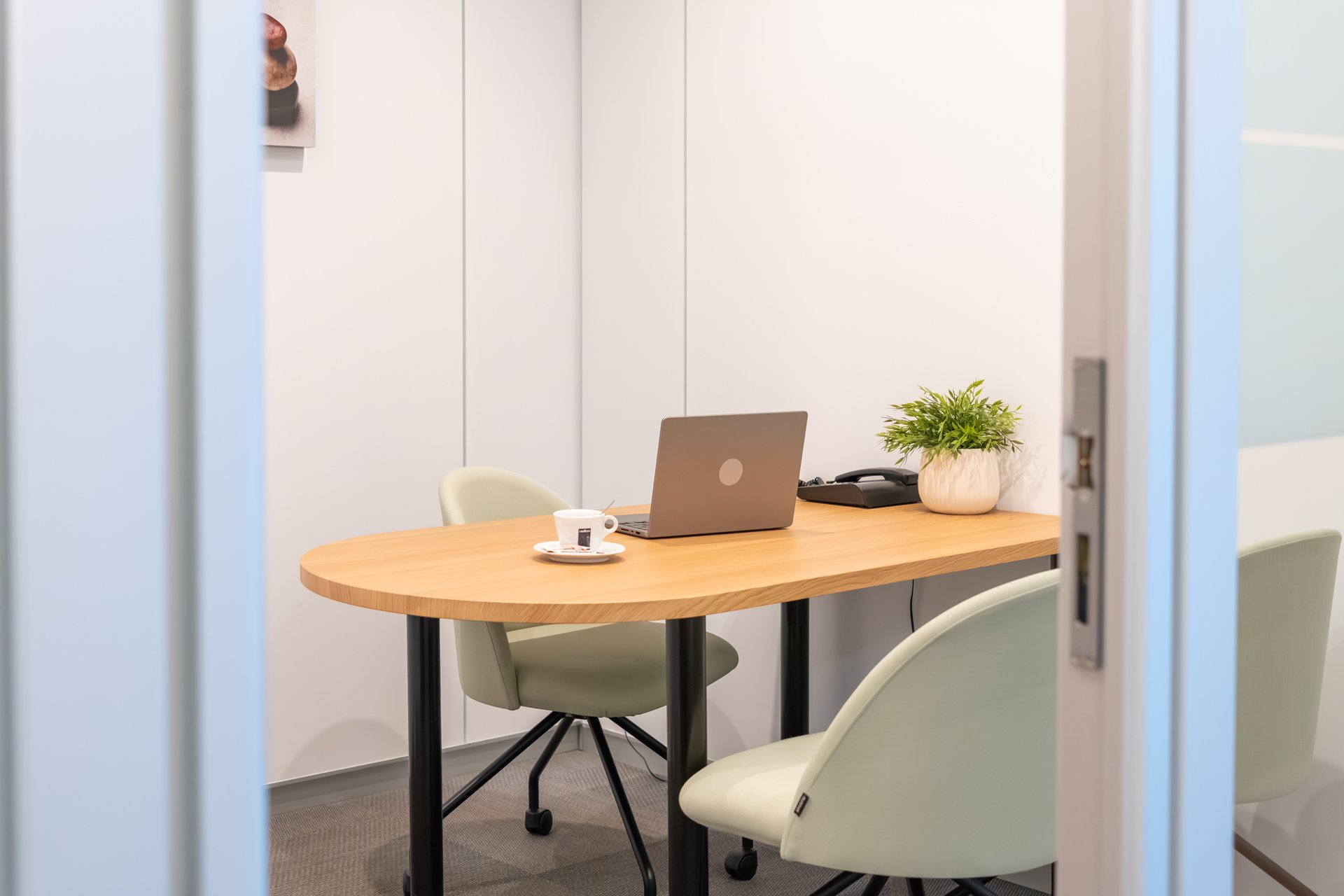
It doesn't mean abandoning flexibility. Nor does it mean signing a traditional multi-year lease, buying furniture, and starting to manage suppliers. For many startups in Madrid, the logical next step is a private office with services: a personal space, ready to use, with greater privacy and room to grow without taking on a heavy structure.
Coworking works very well in the early stages. It allows you to get started quickly, control expenses, and be in a dynamic environment. But a growing startup needs other things: more coordination, more focus, more control over its space, and less daily improvisation.
The key is knowing when that change starts to make sense.
Signs your team has outgrown shared coworking
Initially, sharing a workspace is an advantage. Your team works surrounded by other people, you don't have to worry about the office, and you can easily increase or decrease staffing levels. For a startup of two, three, or four people, this usually works well.
The problem arises when the team no longer uses coworking as support, but as a solution that has to be overcome.
A clear sign is the difficulty in sitting together. If everyone starts the day looking for an empty table in a different area, communication slows down. For individual tasks, this might not be a big deal. But for a team that needs to coordinate product, sales, customer service, or development, it is.
Another sign is noise. In a shared space, the environment changes depending on the time of day, the day of the week, and the people working nearby. If your team makes frequent calls, discusses confidential matters, or needs to concentrate deeply, this lack of control can negatively impact performance.
It is also worth noting the use of meeting roomsIf you need to book rooms several times a week for internal meetings, interviews, investor calls, or client presentations, you're probably no longer just using coworking occasionally. You're trying to turn it into a private office in parts.
Some practical signs:
- The team wastes time looking for available tables.
- Calls are made from common areas or hallways.
- Important meetings are postponed due to lack of a room.
- There are documents, screens, or materials that you don't know where to store.
- Strategic conversations require too much discretion.
- The team needs more continuity to create work habits.
- New employees don't feel like there's a space of their own.
A simple example: a tech startup grows from three to eight people in just a few months. Initially, everyone works with their laptop and makes a few calls a day. Then the sales team arrives, support staff joins, and weekly product meetings begin. Suddenly, the shared coworking space isn't working as well. Not because it's a bad space, but because the needs have changed.
The same applies to companies that handle sensitive information. If you're talking about contracts, financing, customer data, business strategy, or delicate internal decisions, privacy ceases to be a luxury. It becomes part of the job.
The useful question isn't "Are we already too big for coworking?". The question is more specific: "Does our current space help us work better or does it force us to compensate for its limitations every day?"
If the answer starts to lean towards the second option, it's worth considering a private office.
What a private office really costs versus what you think
Many startups delay the move to a private office because they imagine a classic scenario: long contract, high deposit, renovation, furniture, internet, cleaning, supplies, printer, maintenance and someone from the team managing incidents.
That model exists. And for an early-stage company, it can be too rigid.
But a serviced private office works differently. Instead of renting an empty space and building the office from scratch, you get access to a fully equipped workspace. The monthly cost usually includes many elements that are sold separately in a traditional office.
That's why it's important to compare the total cost, not just the rent price.
In a conventional office, in addition to rent, you should consider:
- Furniture.
- Internet installation.
- Supplies.
- Cleaning.
- Air conditioning.
- Maintenance.
- Reception or management of visits.
- Meeting rooms.
- Insurance and other associated expenses.
- Internal time spent coordinating suppliers.
En an office with servicesMany of these elements are already integrated. That doesn't mean it's always cheaper in absolute terms. It means the comparison must be made comprehensively.
For a six-person startup, for example, paying for six coworking spaces might seem reasonable for a while. But if you also frequently book meeting rooms, need spaces for calls, and spend time organizing your week, a private office can come much closer in real cost and offer more stability.
There is another important element: predictability.
In a young company, unexpected expenses can be a significant burden. A breakdown, a poor internet connection, an external room that needs to be rented several times a month, or an impromptu move can throw the budget off track. A clear price list, with services included, helps with better planning.
You also have to calculate the cost of time. If the founder, the head of operations, or someone on the team spends hours solving office problems, those hours aren't being dedicated to the product, sales, customers, or recruitment.
A private office shouldn't be seen simply as "more expense." It can be a way to reduce friction, streamline work, and prevent space management from becoming just another internal task.
How flexibility clauses protect early-stage companies
A startup changes quickly. That's its nature. It can grow after closing a funding round, reduce its needs after finishing a project, or reorganize after modifying its strategy. Signing an overly rigid agreement in that context can create problems. That's why contractual flexibility is so important.
A private office It can be a good decision, but only if it doesn't force the company to behave as if it already has a completely stable structure. Flexibility clauses allow the space to be adapted to the reality of the business, not to a forecast made six or twelve months earlier.
This may include shorter contracts, the possibility of upgrading positions, the option to change offices, clear exit conditions, or access to rooms and services as needed.
It's not about finding a no-commitment solution. It's about avoiding a disproportionate commitment.
Imagine a startup that has just closed a funding round and plans to hire five people in three months. It needs space, but it doesn't yet know exactly how the team will look. Perhaps it will grow faster. Perhaps some new hires will work remotely. Maybe one area of the business won't evolve as planned.
In that scenario, a flexible office makes more sense than a traditional contract that forces you to decide too soon.
The opposite can also happen. A project might be delayed, a major client might not come on board, or the team might decide to keep things leaner. If the rented office space is too large and inflexible, it becomes a burden.
Flexibility protects because it allows you to react.
For growing companies, this has strategic value. It doesn't block future decisions. It doesn't force them to oversize for fear of falling short. It doesn't make the office a heavy bet when the business is still adjusting its shape.
When inspecting a private office, it's advisable to ask detailed questions:
- What is the minimum duration required by the contract?
- What happens if the team grows?
- Is there a possibility of moving to a larger office?
- What if we need less space?
- Which services are included and which ones are paid separately?
- How do I book meeting rooms?
- What are the deadlines for modifying or canceling the agreement?
These are not minor questions. A good office for startups isn't just a pretty space. It's a solution that understands that growth doesn't always follow a straight line.
What does "all-inclusive" really mean in a serviced office?
The term “all-inclusive” may sound straightforward, but it's worth examining closely. Not all spaces include the same things, and not all startups have the same needs.
In a private, serviced office, "all-inclusive" should mean something practical: that the team can arrive, sit down and work without having to build the office from scratch.
Standard amenities typically include furniture, internet access, cleaning, air conditioning, utilities, basic maintenance, reception, access to common areas, and use of meeting rooms (subject to conditions). Some venues also offer additional services, such as correspondence management, catering for meetingstechnical support or administrative solutions.
The difference is noticeable in everyday life.
In a traditional office, if the internet goes down, someone has to call the provider, open a support ticket, wait for a response, and find a temporary solution. In an office with services, the management team should handle the issue directly. For a startup, that difference can save hours and prevent disruptions.
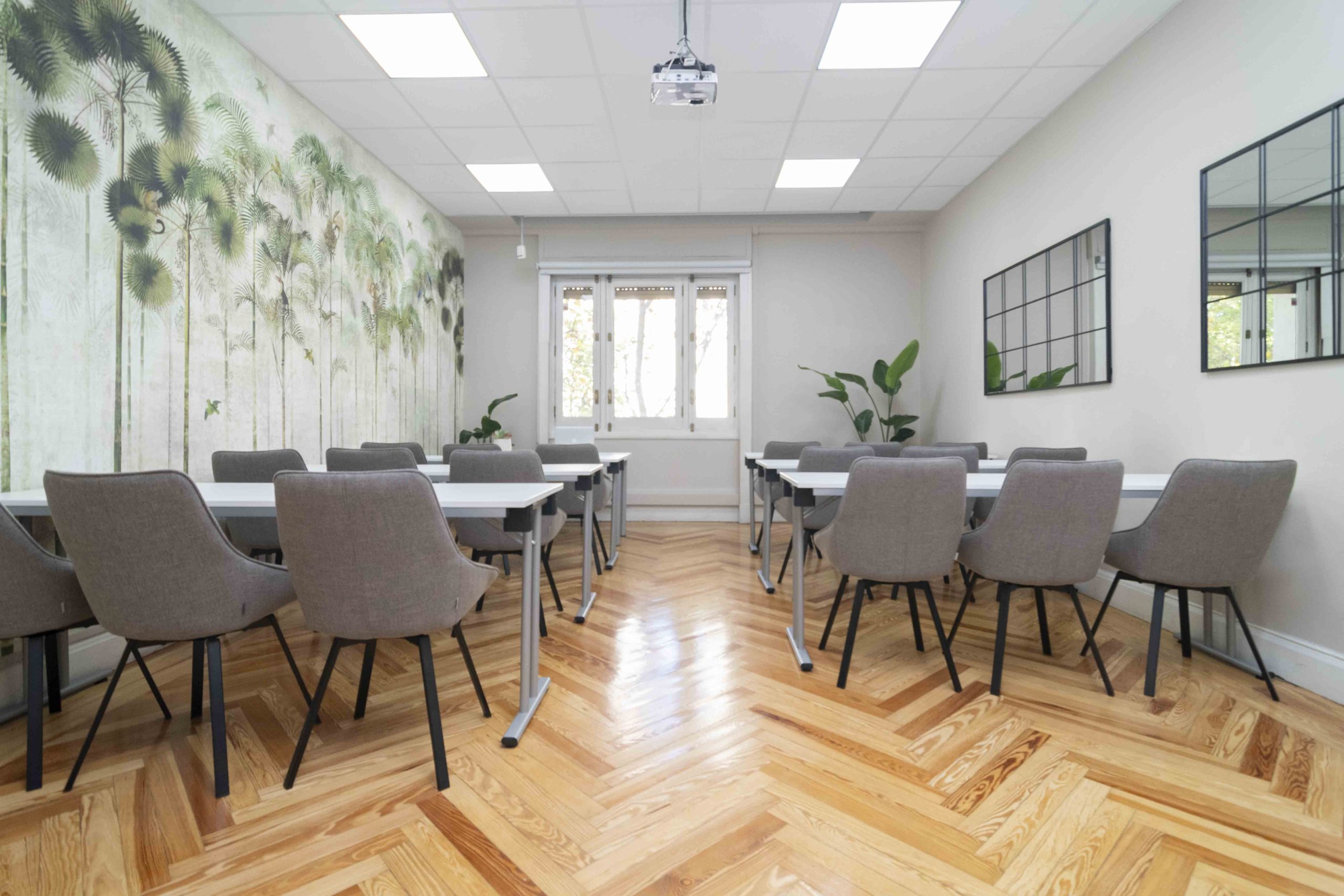
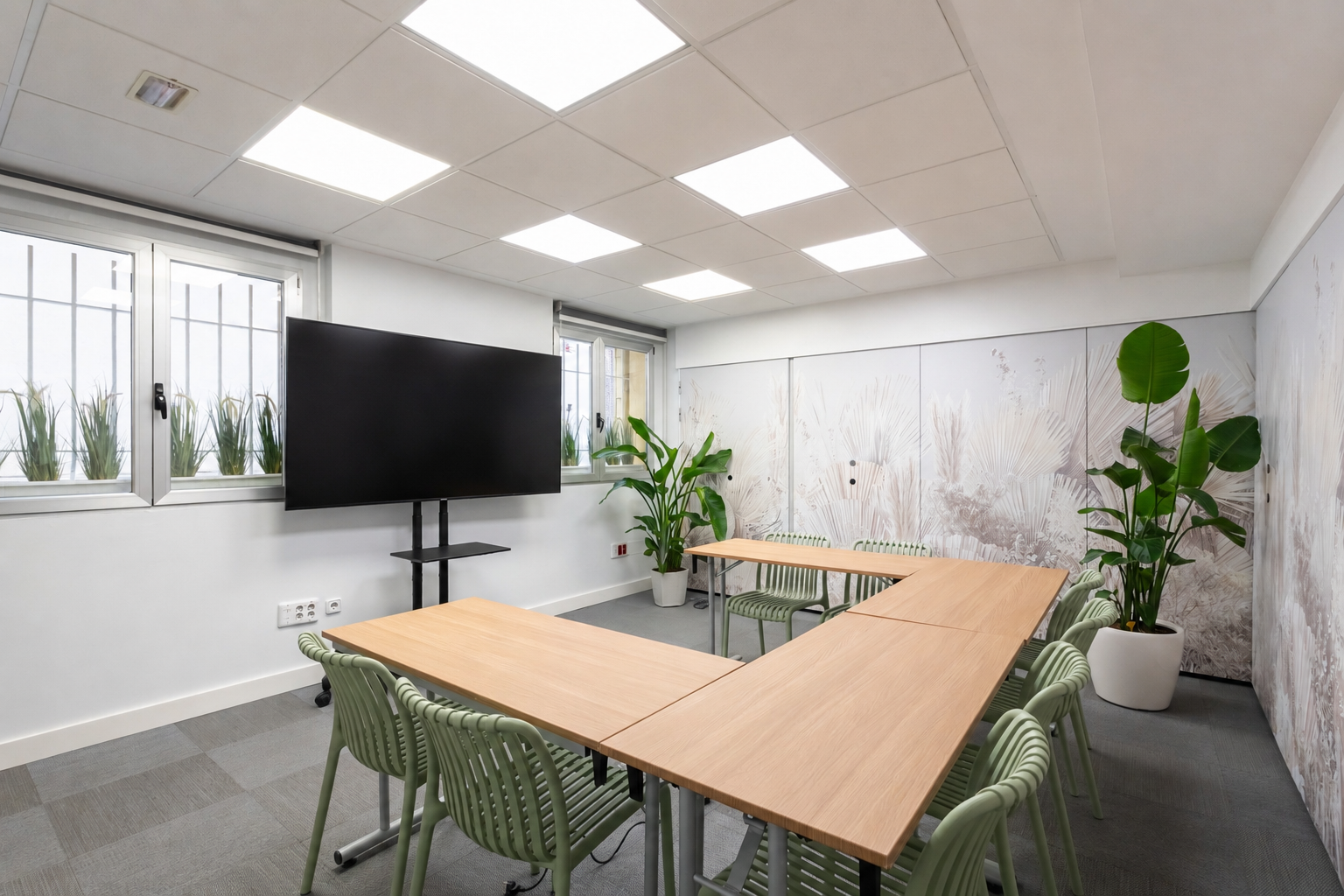
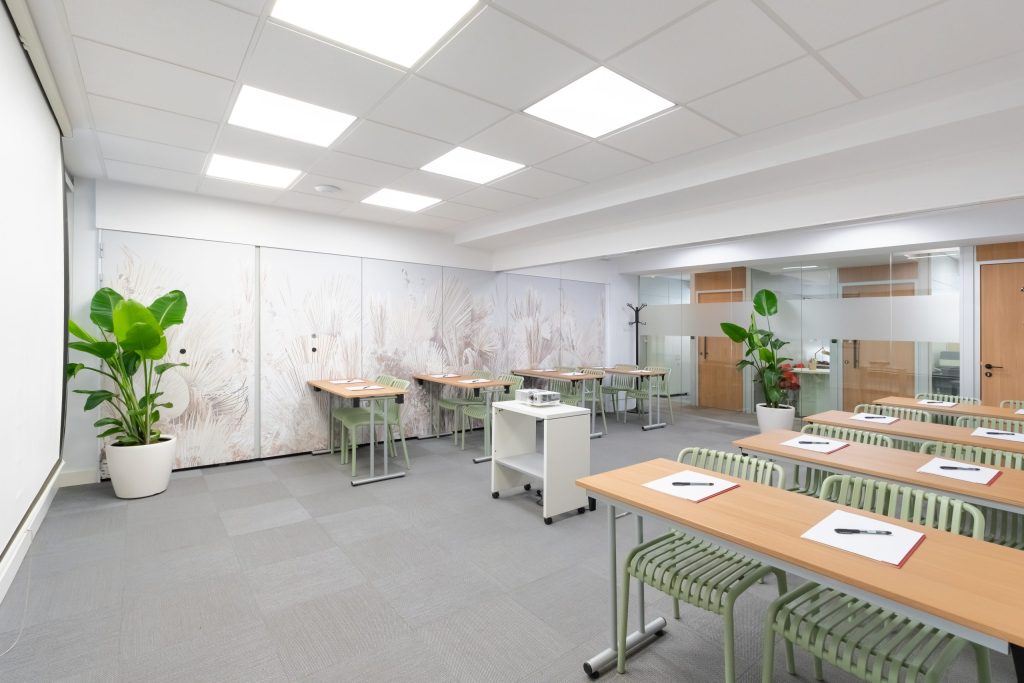
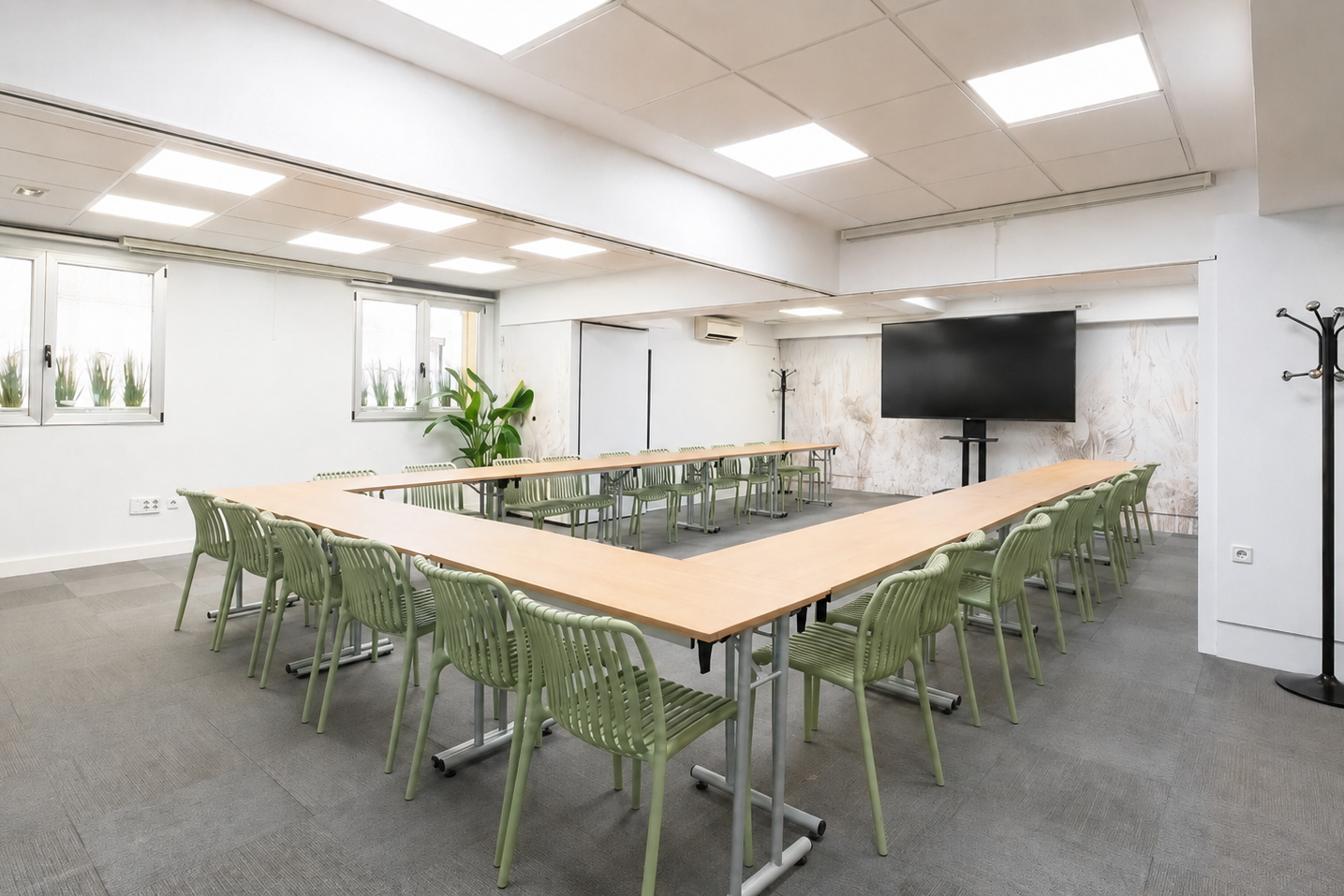
The same applies to meeting rooms. Setting up your own meeting room requires space, a table, chairs, a screen, internet access, maintenance, and cleaning. In a serviced environment, you can use ready-made rooms when you actually need them. This means your private office doesn't have to be larger than necessary.
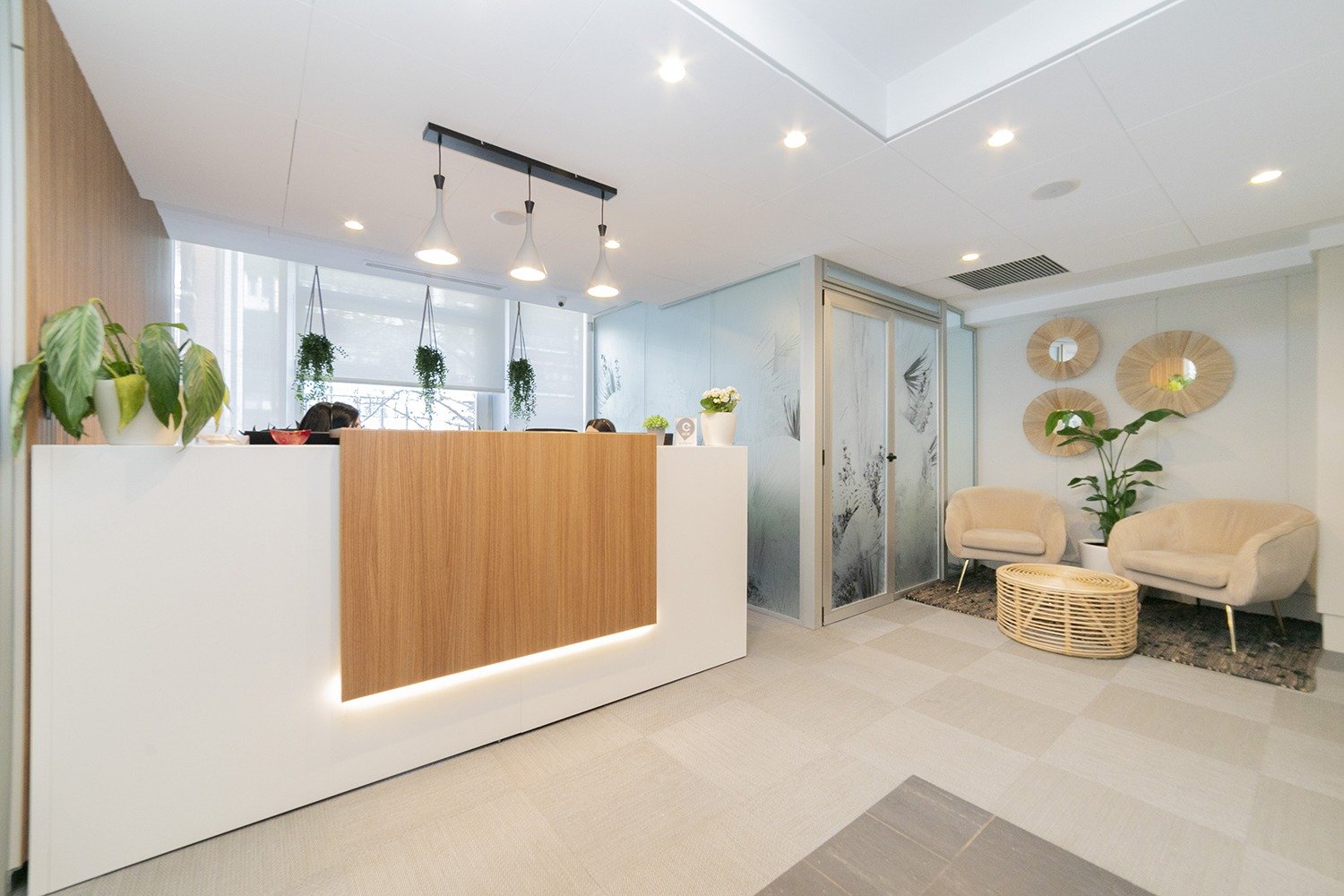
The reception area is also important. If you receive candidates, clients, suppliers, or investors, first impressions count. You don't need a large office, but you do need a tidy, professional, and easy-to-find environment.
For a startup of seven people, for example, it may be more reasonable to have a compact private office and use shared rooms for large meetings, rather than renting a larger space just to have a room that is used twice a week.
That's one of the strengths of the service model: it allows you to use professional resources without having to pay for them exclusively all the time.
Even so, it's worth carefully reviewing what each rate includes. "All-inclusive" should clarify aspects such as:
- Type of furniture.
- Speed and quality of the connection.
- Use of meeting rooms.
- Access times.
- Cleaning.
- Supplies.
- Reception.
- Visit management.
- Maintenance.
- Possible additional costs.
Transparency is key here. A private office should provide reassurance, not create uncertainty. If the team knows what's included, they can budget more effectively and work with fewer interruptions.
How to relocate your team without losing a day of work
An office move can sound like a long project. Boxes, cables, screens, contracts, suppliers, address changes, technical problems, and several days of lost momentum.
But it does not have to be like that.
Once the new space is ready, the move can be much easier. The key is to plan what's necessary without overcomplicating things.
The first step is to define what the team truly needs from day one. Not everything has to be perfect, but it must be functional. This includes tables, chairs, internet access, meeting rooms if meetings are planned, and clear communication within the team.
Next, it's a good idea to prepare a short transition list:
- Which people are moving.
- What equipment does each one carry?
- What common material needs to be moved.
- What digital or physical access is needed?
- What meetings are scheduled for the first few days?
- Which customers or suppliers should be informed of the new address?
- What internal information needs to be updated?
For a small startup, it's often enough to schedule the move for a Friday afternoon and start in the new space on Monday. If the office is ready, the actual move can be minimal: laptops, monitors, a few documents, and little else.
The difference compared to an empty office is enormous. In an unequipped space, before you can even start working, you have to buy, install, configure, and troubleshoot. In a fully equipped office, the goal is for the team to be able to maintain their pace with minimal interruptions.
It's also important to communicate the change effectively internally. Simply saying "we're moving" isn't enough. The team needs to understand why the move is happening, what the advantages will be, how the new space will function, what the basic rules will be, and what will change in the daily routine.
If the team comes from a shared coworking space, a private office can help create a stronger sense of identity. But that identity doesn't appear simply by closing a door. It's built through habits: better-organized meetings, more carefully curated spaces, moments of focused work, and a clearer way of working together.
In Madrid, location can greatly facilitate the transition. If the team already uses public transport, a well-connected space reduces resistance. If you receive external visitors, being close to hubs like Atocha or established business districts can make the move more practical for everyone.
The move shouldn't feel like a break, but rather a natural improvement in the way we work.
A private office as the next step, not as a risky leap
 Moving from shared coworking to a private office doesn't have to be a dramatic decision. Nor does it have to mean losing the flexibility that helped the startup in its early stages.
The main question is whether the current space still suits the team. When shared coworking facilitates work, it makes sense to stay. When it starts to generate noise, distractions, lack of privacy, or wasted time, it's worth reassessing the situation.
A private office It can bring order without isolating the team. It can provide privacy without forcing a traditional office environment. It can help you grow without turning the office into a management problem.
For small and growing teams, that balance is important. The company needs to focus on customers, product, sales, finance, recruitment, and operations. The office should support all of that, not drain energy.
The best time to make a change is usually before the problem becomes obvious to everyone. When there's already too much friction, the team notices: poor concentration, awkward meetings, poorly handled calls, and a sense of impermanence that starts to feel inadequate.
If several of these signs are already present, it's worth analyzing private office options in Madrid with a practical eye. Not from the idea of "appearing bigger," but from a simpler need: to work better, with more privacy, more continuity, and less improvisation.
Shared coworking may have been the right stage to start with. A private office may be the right stage to grow.
Key points
The right time to move from shared coworking to a private office doesn't depend solely on the number of employees. It usually comes when a lack of privacy, team fragmentation, constant meetings, or the need for more coordinated work begin to affect daily productivity.
Before making a decision, it's advisable to analyze the total cost of your current space, review the team's actual needs, and assess the importance of having your own dedicated environment. For many startups, a private, serviced office offers an appealing combination of privacy, flexibility, and cost control, without the hassles of a traditional office.
FAQ
How many people should a startup have before moving to a private office?
There's no fixed number. Some startups need a private office with four or five people if they make a lot of calls, handle confidential information, or need to work together constantly. Others can continue in a shared coworking space with larger teams. The key is to observe whether the current space helps the team or starts to cause interruptions, distractions, and wasted time.
Does a private office mean losing the flexibility of coworking?
Not necessarily. Many serviced private offices offer more flexible contracts than traditional leases. The company can have its own space without having to cover renovations, furniture, supplies, or long-term commitments. The important thing is to review the terms: minimum term, the possibility of expanding the space, included services, and options if the team grows.
What costs should I compare before making a decision?
It's important to compare the total cost, not just the monthly fee. In shared coworking spaces, factor in the cost of individual workstations, meeting rooms, private calls, and time lost due to lack of space. For a private office, check what's included in the fee: internet, furniture, cleaning, supplies, reception, maintenance, and room access. This will give you a more realistic comparison.
What advantages does a private office have for team culture?
A private office can help create shared habits and a stronger sense of belonging. The team can sit together, hold quick meetings, leave materials in the space, and have internal conversations more naturally. This is often helpful when a startup begins hiring new people and needs to strengthen coordination, communication, and continuity.
How to prevent the move from affecting daily work?
The best approach is to choose a ready-to-use space and plan only the essentials: access, internet connection, workstations, equipment, scheduled meetings, and internal communication. If the team uses laptops and the space is already equipped, the move can be made with minimal disruption. It's also advisable to update the address, suppliers, and calendar before the first day.
What should I ask before hiring a private office?
Ask exactly what's included in the rate, what services cost extra, how the meeting rooms are managed, and what happens if the team grows or shrinks. It's also worth asking about internet access, hours of operation, reception, maintenance, exit policies, and the possibility of changing offices within the same building.