Remote work solved part of the problem: you no longer need to commute to an office every day. But it left three very specific questions unanswered, questions that often arise when a business starts to grow. What address do letters and packages arrive at? What address do you put on your website, invoices, and contracts? And when you really need to see a client or get the team together, where do you do it?
This article is not about what a virtual office is (we already talked about that in our guide on How to establish a legal business address in Madrid). It's about something more practical: how to set up your remote work setup so that your address, correspondence, and physical spaces are organized without paying for an office you won't use.
Why your home isn't always the best professional address
Working from home is convenient and, for many professionals, the preferred option for their daily work. The question is: is it advisable for a partner's or administrator's home address to also be the public face of the company? There are four reasons why many small businesses are reconsidering this.
- Privacy: A business address ends up appearing in many places: the website's legal notice, invoices, quotes, and contracts with clients and suppliers. In the case of companies, the registered office is recorded in the Commercial Registry, which is publicly accessible. If that address is the home of a partner or director, it's visible to anyone.
- House rules: Some rental agreements and homeowners' association bylaws limit or prohibit conducting business in the property. It's advisable to check these before assuming there's no problem.
- Logistics: Registered letters, paper notifications, courier services, and deliveries have a bad habit: they arrive when you're not home. Letters not collected on time are returned, and some communications have deadlines that run even if you haven't seen them.
- Image. There are clients, banks, and organizations that value seeing a professional management style. It's not a universal requirement, but in certain sectors (consulting, financial services, legal, projects with large companies) it influences the perception of stability.
If you want to see the other side of the coin, the real cost of working from home, we analyze it in Why does your home office cost you more than a coworking space?.

Professional direction and management
This is where caution is advised, as it's where most mistakes are made. A professional address handles the commercial and logistical aspects very well. However, it doesn't, on its own, determine your tax domicile.
The General Tax Law (Article 48) establishes, in general terms, that a company's tax domicile is its registered office, provided that the administrative management and direction of the business are effectively centralized there. If this is not the case, the tax domicile is determined by the location where such management or direction is carried out. Natural persons are governed by different rules (generally, their tax domicile is linked to their habitual residence), so this model is designed for companies.
In practice, this means that for a company with a remote team, the relevant question isn't just "where do I receive my mail?", but "where are the decisions actually made and the business managed?" That's why many remote companies adopting a professional approach supplement their existing structure with additional features: partner or management meetings in a physical office, well-organized documentation, and advice from their accounting firm.
It's not a legal guarantee, nor does it replace an advisor, and every case is different. But it is a good reason to consider the address and physical spaces. as a setand not as two separate decisions.
How to organize remote work effectively
There are different types of services that can be contracted separately or combined; for this, we propose completing three layers.
Layer 1: address and correspondence. It's the basics: a professional address you can use according to the service terms, and someone to receive and hold onto your package until you pick it up. That's what a basic legal address for those who only need that.
Layer 2: attention. What happens when someone shows up or calls asking for you? A receptionist who greets visitors prevents a customer from finding a closed door or an unanswered intercom.
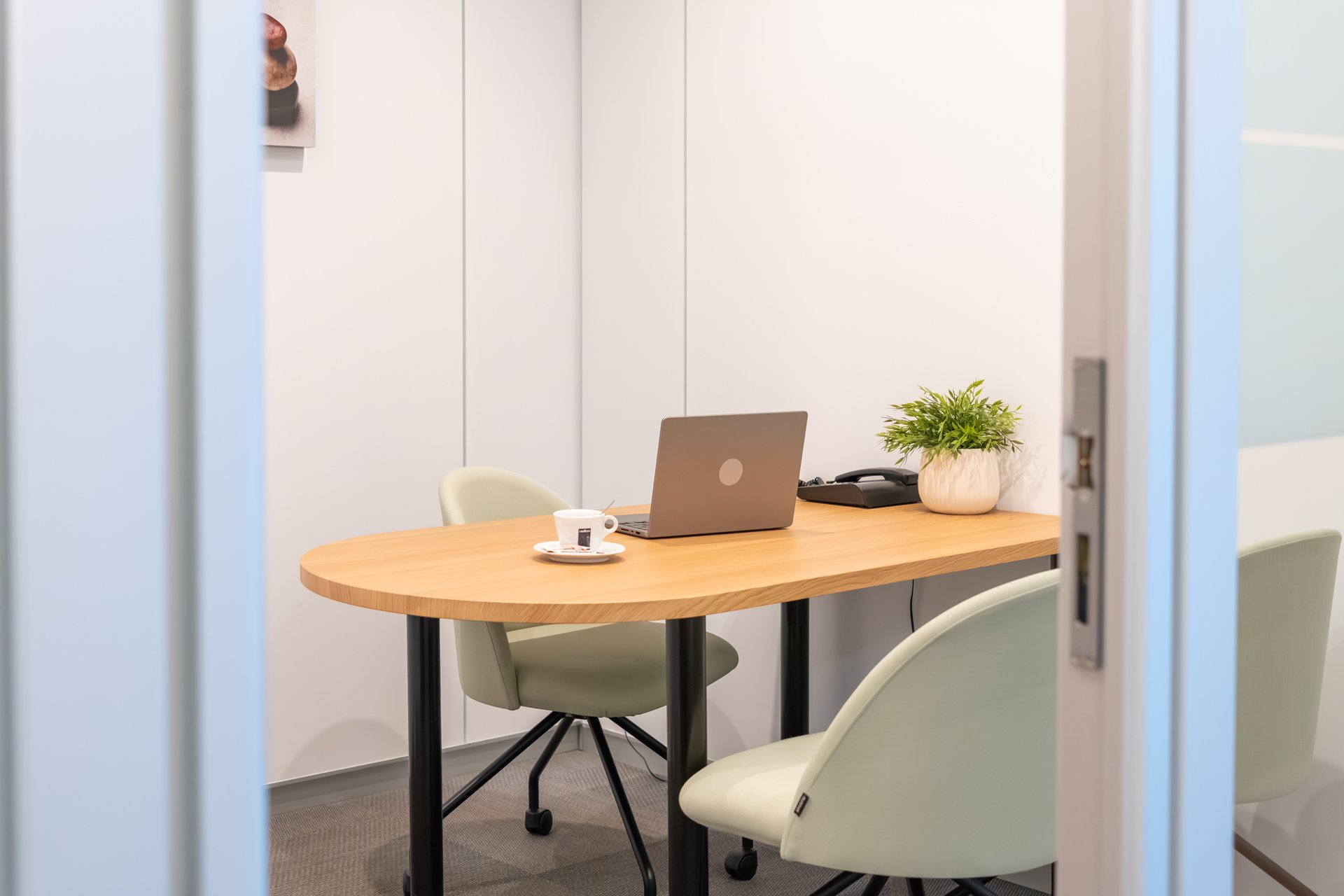
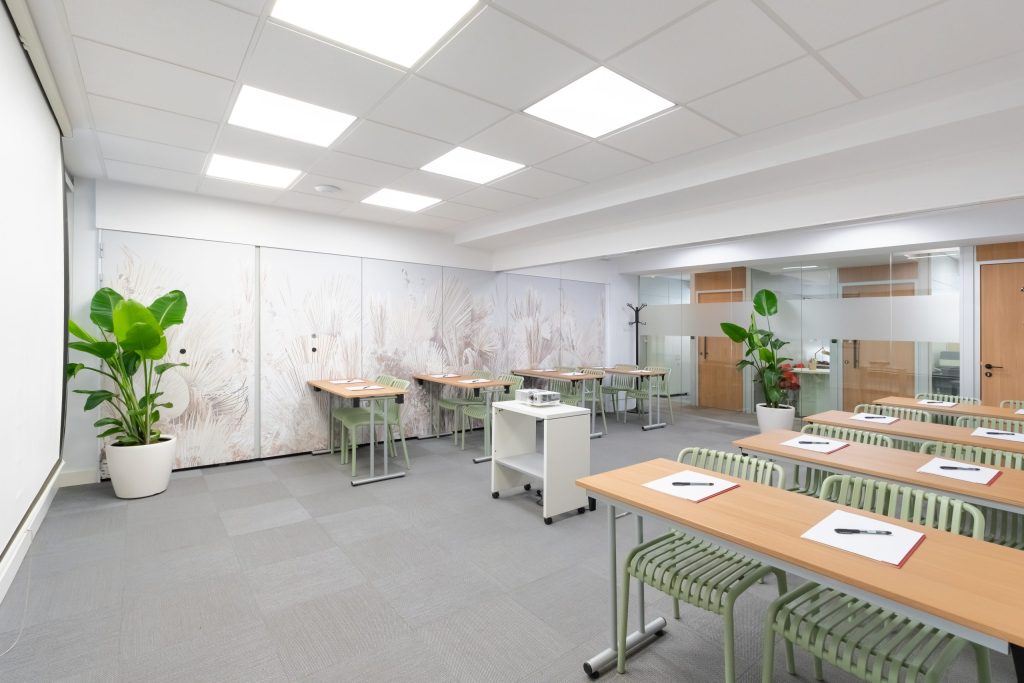
Layer 3: physical space on demand. It's what makes remote work possible without isolation: a coworking space when you want a change of scenery, a meeting room when you need to meet with a client or your team, or an office by the hour when you require privacy. This is why options like the virtual office with access to coworkingwhich combine management with a flexible position and a discount on meeting rooms.
The key is to only hire what you're really going to use and leave the door open to adding other services when the business requires it.
What kind of profile are you? Four common cases
| Profile | Primary need | Reasonable combination |
| Small company with a 100% remote team | Registered office with real estate backing; regular team and partner meetings | Address + room for quarterly meetings or assemblies |
| Startup or company in its early stages that does not yet need a fixed office | Professional management and flexibility to grow without rental commitments | Address + flexible coworking; move to a private office if the team grows |
| Digital business or ecommerce incorporated as a company | Receiving documents and, sometimes, packages | Address + prior consultation regarding parcel and storage |
| Company with a team spread across several cities or headquartered outside of Madrid | A recognizable meeting point and local presence | Address + flexible coworking + meeting room |
One clarification regarding the third case: a virtual office is not a warehouse. If your business receives merchandise or stock, ask in advance what parcel management and storage options are available, and which ones have an additional cost.
For teams spread across multiple cities, we also have a specific guide on How to organize company meetings when the team is distributed.
One month example: how it's really used
To put this into practice, here's an illustrative example. Imagine a small human resources consulting firm, incorporated as a company, with three partners working from Alcalá de Henares, Valencia, and Zaragoza, and which doesn't need a fixed office.
- 1 Week: Mail arrives at the company's address. They receive the notification and a partner who happens to be in Madrid picks it up.
- 2 Week: One of the partners is preparing a workshop with a client and spends the morning in a coworking space.
- 3 Week: Two partners meet with the director of a client company in a meeting room, instead of meeting in a noisy cafe.
- 4 Week: Everyone works from home. That month they don't use any physical space.
- Once per quarter: The three partners meet in a room to review results and record the decisions.
The value lies in that flexibility: the direction is consistent, and the physical space is used when it adds value. If you want to fine-tune which room suits each type of meeting, our guide on [the topic] will help. Which meeting room do you need based on your meeting?.
Checklist: What to check before hiring a professional manager
Not all services include the same things, and many problems can be avoided by asking a few questions beforehand:
- Permitted uses. Can the address be used as a business address? As a registered office or tax address? On websites, invoices, and contracts? Request that it be in writing.
- Type of correspondence. Do you receive regular mail? And registered mail, notifications, or courier services? How and when are you notified?
- Custody and collection. How long do you store incoming items? Are there collection hours?
- Attention to visitors. Who answers the door when a customer shows up unannounced?
- Access to spaces. Does it include a coworking space, how many days, and under what conditions? Is there a discount on meeting rooms?
- Contract conditions. Stay, payment method and discounts for early payment.
- Location. Is it easy to get there by public transport from where you live or where your customers travel from?
- Evolution. Can you switch to another service if your team grows, without starting from scratch?
- Data Protection. How do they handle the data they receive on your behalf?
Some of these questions are also answered in our article on What's included and what to ask before booking a meeting room, designed for the physical space layer.
Common mistakes when setting up remote work with a professional address
Hiring without reading the permitted uses, This is the most common mistake. An address that works for your website and business cards isn't necessarily valid for all administrative procedures.
Thinking that management solves everything. As we saw earlier, having an address doesn't replace a legal and tax analysis of your case. Consult your accountant beforehand, not afterward.
Do not update the change of address. If you change your address, you must notify the Tax Agency, Social Security, your bank, your clients and suppliers, and, in the case of a company, follow the corresponding commercial procedure for changing its registered office. Your business advisor can guide you through the exact steps.
Paying for what you don't use, or falling short. If you rent more space than you use, you're paying for nothing. If you rent less than you need, you end up improvising meetings in substandard venues. Review your actual usage every quarter.
When is it time to take the step towards having your own office?
A professional address with on-demand space doesn't have to be permanent. It's a good option while your team is small and their needs are occasional. There are clear signs that it's time to evolve: you use coworking several days a week, you start hiring people in the city, you receive clients frequently, or you need a permanent place to store equipment. If this sounds like you, our guide on [topic missing] will be helpful. When to leave coworking and switch to a private office.
Professional management in summary
Working remotely doesn't force you to choose between working from home and paying for a full office. There's a reasonable middle ground: a professional address that organizes correspondence and protects your privacy, and physical spaces you use only when you truly need them. The key is understanding the function of each element, verifying the permitted uses in writing, and reviewing your specific situation with your advisor.
If you only want the address with mail reception and a discount on meeting rooms, you can consult our Legal address for companiesIf you also want a flexible job, check out the virtual office with coworking in Atocha or Abascal. And if you have any doubts about which combination suits you best, you can write to us and we guide you.
FAQ's
Can my team work from home if the company has a professional address?
Yes. It's a very common situation among companies with remote teams. The professional address is used for correspondence, the website, and business documents, while daily work continues to be done wherever you prefer.
Do I have to go to the office to use the service?
Not necessarily. Many clients only drop by to pick up mail occasionally. If your service includes coworking or a discount on meeting rooms, you only use it when it suits you.
Can a professional address serve as the registered office of a company?
It depends on your situation. For companies, the tax domicile is the registered office when the management and direction of the business are centralized there; otherwise, it's the place where business is conducted. Before using a business address for tax purposes, consult with your accountant or tax advisor.
Can I receive certified letters or notifications?
It depends on the terms of each service. Some only include standard mail, while others offer more options. Always ask what types of shipments are handled and how you'll be notified.
What happens if my business grows?
It's usually possible to upgrade to another service: add coworking, meeting rooms, or an office. That's why it's a good idea to ask how this change is handled when you sign up.